Saturday, September 20, 2014

IN SCENA: Fallaci, a Woman Against


June 19, 2014

In a sense, a reading is a greater test of a script than a full-fledged play, precisely because in a reading all you have are the words.  But what could be more appropriate for a figure as invested in words as Oriana Fallaci?   She is the subject of “Fallaci, a Woman Against,” one more performance in the eclectic two-week run (June 9 -24) of In Scena, the Italian Theater Festival taking place in all five boroughs of NYC.  Go here for the calendar:   

I hesitate to call her a journalist because she so completely rejected that characterization. 
Hear that rejection in her own words convincingly delivered by actress Andrus Nichols whose portfolio of characters includes another strong woman – Bernard Shaw’s Saint Joan.  

Instead of journalist, the writer’s words in the mouth of the actress carefully explain that the moniker she prefers is historian in the moment.  She imagines interviewing historical figures like Joan, Caesar, and Napoleon with the same intensity, challenge and distrust she applied to Henry Kissinger, Golda Meir, Willy Brandt, Nguyen Van Thieu, Ayotollah Khomeini and other elusive, prominent figures of her day. 

Imagination and poetry are at the heart of this production.  Playwright Emilia Costantini has weaved Fallaci’s own words together to create an interview that never took place.  Two women sit on chairs facing each other, interviewer and interviewee, exactly the kind of free-ranging discussion of herself Fallaci never agreed to in life.

The poetry is in the depth of the subject matter and artfulness of the words that make up Fallaci’s responses.  She will tell us that writing is the most strenuous job in the world and that only written words have lasting value, that disobedience to the arrogant is mandatory – the only justification for the miracle of being born, if we do not protest injustice we are like leaves dragged in the wind, that war is the bane of human existence, that politics as a career is destructive to the world, that love is unknowable, that there is no reality like the death of a mother because it anticipates your own.  She is a professed atheist, an eloquent spokesman for the soul, a woman at one with and against the history of her times.

All of this comes through.
-----------------------------------------------------------------------

Written by Emilia Costantini
translated and adapted by Dave Johnson and Laura Caparrotti with help from Carlotta Brentan


Fallaci played by Andrus Nichols    Full In Scena Calendar:  http://www.inscenany.com/

IN SCENA: Hanno tutti ragione – Everybody’s Right

June 14, 2014

If you’re ready for something entirely different or if you’re naturally drawn to things Italian – and who isn’t?  – mark your calendar for the In Scena Italian Theater Festival, beginning with this unique play.  The festival runs in all five NYC boroughs through June 24. Go here for the calendar:  http://www.inscenany.com/ 

This is a play based upon a novel written by an award-winning movie director, Paolo Sorrentino.  The novel is nearly 400 pages long; the play is less than 5,000 words delivered by a woman playing a man, animating the dialogue impeccably with dance, gestures and song.   Every spoken word is in Italian but that is absolutely no barrier for non-speakers thanks not only to the English super-titles that display above the action but also to the richness of the delivery.  If anything, this play is a tutorial in how much more than words there is to a meaningful performance.

Tony Pagoda, lounge singer, world-weary like all of Sorrentino’s characters, regardless of the medium, is about to experience what should be one of the highlights of his career – a performance at Radio City Music Hall where none other than Frank Sinatra will be staring back at him from the audience.

Iaia Forte, the actress who played Trumeau in Sorrentino’s Oscar-winning “The Great Beauty” (La Grande Bellezza) rivets your attention as Tony.  Only one other character intermittently appears on stage – a woman with whom Tony dances provocatively.

Life is a song.  Life is a dance.  Tony may not be at the end – the music is still playing – but he’s definitely past the middle.  He’s stuck in that moment that seems to fascinate Sorrentino – when his characters can no longer escape the conclusion that the promise of abundance has failed.  Tony is disenchanted with the world, but he cannot claim innocence, none of us can.  

Tony Pagoda is past the point of fixing anything.  He can only be eloquent about the place to which he has arrived.  This eloquence Iaia Forte embodies for us.  In the telling, she makes us forget that she is a woman playing a man, or that she is speaking a language that may not be our first.  As Tony, she rails against all of those things that disgust him; Tony finally tells us he only likes “nuance.”  Iaia Forte gives us nuance.

I do see in all of Sorrentino’s work a flicker of hope – circumstances do not change, nothing develops except the possibility of understanding.  For Tony what flickers is one word – a name with reverberations in the literature of his homeland – Beatrice.

The In Scena Theater Festival is like an Italian feast made up of endless courses.  That’s what I felt when Executive Producer Carlotta Brentan enthusiastically outlined for me the week’s lineup, like a master chef lavishly describing the specials on the menu.  I have my eyes on three tempting dishes.  Buon Appetito!
-------------------------------------------------------

Once again, the full In Scena calendar:  http://www.inscenany.com/
Hanno tutti ragione – Everybody’s right
Based on the novel by Paolo Sorrentino
Tony Pagoda aka Tony. P – Iaia Forte

Director Tony Servillo

Thursday, September 18, 2014

HUMAN FRUIT BOWL


March 30, 2014

This play is a spoken meditation on so many things – art, subjects, objects, knowing, not knowing, thinking that we know when we really don’t – heady stuff – embodied throughout in the quiddity of the naked, young girl standing before us.

Let’s admit we can’t take our eyes off her.  But we also can’t stop listening to her.

This is a unique experience.  When before have playgoers been offered pencil, paper and a lapboard so they can draw what they see?   (The image at the top of this review is a snapshot of a sketch that the woman sitting next to me kindly let me take). 
 
The audience transforms into a live drawing class with an “inside view” that no live drawing class ever gets – the inner life of the model.  

Take a string of things – a heterogeneous parade through the mind – errands she has to do today, the next pose, artists we think we know, models we don’t know except for their names, why is that, famous, infamous, smells, stories, sights, sounds – and the fragmentary return of a rumor of suicide – like a tune that keeps coming back each time in a slightly different key -- when did it happen, why did it happen, how did it happen, did it even happen?

This is what transpires when the subject is an object with its own subjectivity and we dare to explore it.  Distinctions blur.  The play’s multimedia production holds up for our reflection paintings as special objects worthy of a museum because this many years later they emanate with the energy of their little known subjects.

Human Fruit Bowl is a well-conceived, well-written, well-acted experience.  It’s more than a play.  It’s an education.

Bravo playwright Andrea Kuchlewska!  Bravo director Jessi D. Hill! Bravo actress Harmony Stempel for a brave, compelling performance – you turned us inside out.  

--------------------------------------------------------------

Baruch Performing Arts Center in association with terraNOVA Collective & soloNOVA Arts
The Rose Nagelberg Theater at Baruch
55 Lexington Ave. at 25th Street
Performances Thurs, Fri 8PM; Sat, Sun 3PM, thru April 11

TICKETS:  email ron@spincyclenyc.com or CALL 212-505-1700 x. 11

LUCKY ME


August 11, 2014 

“Lucky me,” I was thinking to myself once again as I sat in the NJ Repertory Theatre in Long Branch, because this theatre is such a find.  Twenty minutes before show time were enough to quietly marvel at the set – a seemingly fully-functional kitchen, a dead ringer for the ones audience members may have just left on their way to a play about to start.  It reminded me how much and varied artistry it takes to bring the mere words of a script to life which must be why they call it – a production.

As it turns out, in “Lucky Me” the set plays a major part.

“Lucky me,” I was thinking to myself once again as I sat in the NJ Repertory Theatre in Long Branch, because this theatre is such a find.  Twenty minutes before show time were enough to quietly marvel at the set – a seemingly fully-functional kitchen, a dead ringer for the ones audience members may have just left on their way to a play about to start.  It reminded me how much and varied artistry it takes to bring the mere words of a script to life which must be why they call it – a production.
As it turns out, in “Lucky Me” the set plays a major part.

So do the actors, of course, with a dyspeptic, comedic Dan Grimaldi at the center of the action playing the part of Leo, by turns predictable and unpredictable, but always excruciatingly entertaining.  He fills us with doubt – about whether he actually perceives the things he says he does and about whether he’s actually devoid of the sense he acts as if he doesn’t have.  He delivers that rare level of acting that makes a script even more interesting than it may be.   Not only is the actor acting but so may be the character he portrays.  This keeps the audience on its toes and moves the action along.

Wendy Peace as Sara is also hiding something.  She’s made her peace with events we witness bordering upon the comically supernatural, which is where the set comes into play.  But there is also a bigger reality she is not talking about, which may explain her very convincing hesitancy about well… everything, including Michael Irvin Pollard as Tom, smitten and persistent, in spite of everything.  He is the only character in the play without a sense of foreboding.  We wonder whether his job as a TSA Agent has inured him to worrisome signals, which gives us a sense of foreboding for our own lives outside of the theatre, if he’s typical. 

Mark Light-Orr as Yuri, the young landlord, gives dimension to what in other hands would be a one-dimensional role.  We like him and we like his accent, and we’re thankful to him for helping to unravel the mystery in such dramatic fashion.
 
Fireworks, failing lights, and an unbelievably realistic rainstorm make us bow to set designer Jessica Parks, lighting designer Jill Nagle and sound designer  Merek Royce Press. 

Director SuzAnne Barabas draws impressive performances from an excellent cast.  The interaction between the actors carries the day.  I’ve also resolved to arrive 20 minutes early for every upcoming performance to let the set begin the play before the play begins.
------------------------------------------------------------------
Show runs through August 31.  Performances: Thursdays, Fridays at 8pm; Saturdays at 3pm & 8pm; Sundays at 2pm and selected Sundays at 7pm. 
Written by Robert Caisley; Directed by Suz Anne Barabas.
Cast: Dan Grimaldi as Leo; Mark Light-Orr as Yuri; Wendy Peace as Sara; Michael Irvin Pollard as Tom.
Set Design by Jessica Parks, Lighting Design by Jill Nagle, Sound Design by Merek Royce Press,
Costume Design by Patricia E. Doherty, Properties by Jessica Parks, Technical Director, Michael "Rusty" Carroll, Stage Manager, Jennifer Tardibuono    

Wednesday, September 17, 2014

A VIEW of the MOUNTAINS


April 30, 2014

Count your blessings.  That’s what audiences at playwright Lee Blessing’s “A View of the Mountains” can do through April 26 at the New Jersey Repertory Company in Long Branch.  So can all the residents in surrounding areas – to have such a theatre within reach.  Once again, the set, the acting, the direction, the intimacy achieved between audience and performers reach a level of excellence that begins with the choice of material.  “The play’s the thing,” and for that, we need to thank Mr. Blessing.

A number of years ago I saw his “Cobb” off-Broadway in NYC where the three characters on stage were the infamous hall-of-fame baseball player at three different stages in his life.  They argued, taunted, questioned each other and tried to explain themselves as any of us who has lived more than a few years does within ourselves nearly every day.   This innovative staging of character made an impression that has never left me.  In “A View of the Mountains,” the debate is just as familiar, because it echoes the current national political polarization and the ageless conflict between father and son.

The action is very quick.  This is a compliment to all involved when you remember that the substance out of which the story emerges is made up of only words.  This is the art of theatre at its best, and for some reason that seems to get communicated more thoroughly in confines this small in size.

“A View of the Mountains” is a sequel to “A Walk in the Woods,” Mr. Blessing’s earlier play about a US arms negotiator and his Russian counterpart.   Thirty years later, we encounter that arms negotiator in his comfortable home on the Hudson anticipating an uncomfortable visit from his son, the junior senator from Tennessee, radically different from his father in political ideology.

What transpires is the acting out of differences within a family – memories, anger, disappointment, comedy – physical comedy – and the revelation of secrets…

Eva Kaminsky embodies the role of Gwynn, the senator’s wife.  She’s comic in the extreme, energetic, highly expressive, single-minded, an audience magnet.   John Little as the arms negotiator is reflective and strategic; he gives us a man with experience.  Katrina Ferguson as the negotiator’s wife strikes the right ironic balance; a late entrant into this family drama, she is alternately amazed and amused.  Michael Zlabinger as “Will” has very little will; he convincingly shows us someone under the influence of external circumstances and forces, including his own wife.  The teenage son of the arms negotiator and Ilsa, half-brother to Will, is played with complete familiarity by Jon Erik Nielsen or Jared Rush in different performances.
---------------------------------------------------------------
Directed by Evan Bergman; set design Jessica Parks; lighting design Jill Nagle; costume design Patricia E. Doherty; properties Jessica Parks; technical director Michael “Rusty” Carroll; stage manager Jennifer Tardibuono; fight director Brad Lemons.

Performances through April 26:  Thursdays, Fridays at 8pm; Saturdays at 3pm & 8pm; Sundays at 2pm and selected Sundays at 7pm.  New Jersey Repertory Company; 179 Broadway, Long Branch, NJ 07740 (732) 229-3166  http://www.njrep.org/

Tuesday, September 17, 2013

Yankee Wives


   Okay, I admit it.  Right up until the start of the play I was checking my cell phone for the score of the game.  Yankees-Red Sox in a year when New York needs every win it can get to stay in the race makes for drama.   Earlier in the week it had occurred to me how much the last month of the season to a baseball fan whose team is in the run resembles one of those hit series that have taken over television where fans tune in because they must see what happens next.    Until this play, I’ve never really thought about the wives of the players.
     I was about to be introduced to five women, and then a sixth.   I don’t think I’ve seen many productions of any kind in which the entire cast is of one sex, except maybe for POW films where an escape is being planned.   The only male presence for the next few hours would be the disembodied voice of the announcer – unreal and distant from the action happening between and among the women, as distant as their offstage husbands.
     I say “between and among” because conflicts happened to pairs and then the group reacted, just like in real life.  There are secrets but nothing stays secret for long, just like in real life, and there is a transformation that takes place.   I’m not being flip when I say that changes in hairstyle signaled that a change had happened to the character on the inside.
     The play takes place in a locker room, which is metaphorical, at least more metaphorical than the seating section for wives in the stands.  
     The sixth woman who stepped on the stage, the rookie wife, Wyla, played by Eliza Simpson, stole the show for me.  To be fair to the others, all excellent in their roles, her character is written to do that.    Their historical conflicts, their hierarchy, their way of interacting for what we fell is years set the stage for her arrival.
She is awkward, innocent to a point, untutored, easily awestruck and absolutely genuine.   She completely embraces the role.  She handles the comedy very well.  The best compliment I can give is that you instantly feel that that you know her.
     Samantha Strelitz as Pam, the Olympic swimmer with a record of athletic success all her own but whose husband can’t hit the curveball, conveys well that combination of paradoxes that makes up a real person.  To say more would be to give way too much. 
     Chudney Sykes, as Marceline, wears well the trappings of her role – she is the wise one, mature, forgiving, always steady.   Jennifer Laine Williams as Sally is the convincing Queen of the locker room, disciplinarian, keeper of the faith, will she ever see another way?   Cristina Marie and McKenna Fox as the duo of Connie and Ronnie anchor the action with a comedic, matter-of-fact routine.
     “I wish every woman could have a baseball card of her husband,” says the rookie wife early in the play.  By the end of the action, you might conclude that the women have come into their own… maybe the husbands should have baseball cards of their wives.
     At intermission, when I checked my phone, I was distressed to see that the Red Sox had a 4-2 lead.  At the end of the play, I walked briskly from 26th Street to Penn Station, troubled that the score was now 7-2.   Thirty minutes early for the next train, I sought out the bar where I watched, hope against hope, the home team roar back to a 7-7 tie.   
Sitting in the train, moving in and out of the tunnels, gaining and losing connection, my cell phone told me that we were ahead 8-7, then that it was tied 8-8. 
Arriving in my town, I walked to the bar near the station and watched the final unraveling, only me and the bartender.  He was pessimistic about our chances and he was right.  We lost 9-8, a heart-breaker.
    “I’d better go,” I said to him.  “I have a review to write.”

Play runs through 9/15.  Hudson Guild Theatre, 441 West 26th Street. More info www.yankeewives.com

Playwright/Director David Rimmer. Set design by Allison McGrath, Lighting design by Ian Edward Smith. Costume design by Ramona Ponce. Sound design by Matthew P. Morris. Fight choreography by Dan Renkin. Produced by Group Theater Too.

Monday, September 16, 2013

Einstein

This is a play about history, science, philosophy, obscurity, celebrity, but mostly about change, the kind of revolutionary change that defined the modern world for better and worse, and how it sprang from the imagination of a single man. 
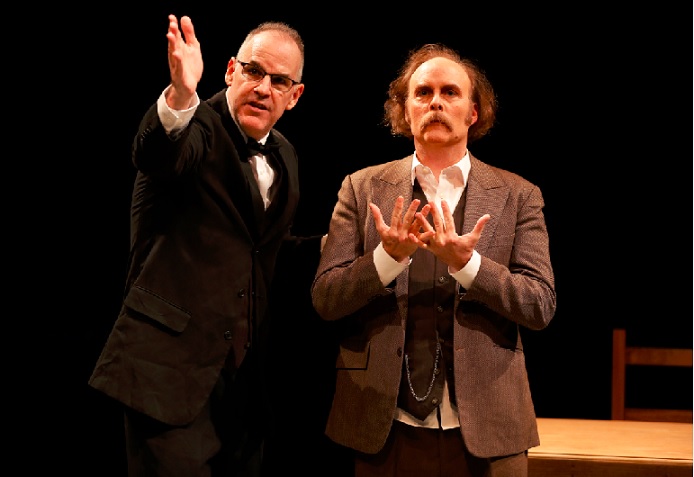
     Richard Kent Green is an excellent Einstein.  He is the only actor who does not play more than one part in this performance.  In a subliminal way this reinforces our focus on him as a singular figure at the center of his own self-conscious history; around him other people swirl, come into existence and disappear; they are the actors in his life.
     In 1962, Thomas Khun wrote a book called “The Structure of Scientific Revolutions.” It would be considered an important book if it had done no more than plant the meaning of one word in our minds – paradigm.  
     There are changes all the time but only extremely rarely is there a change in paradigm, an entirely new, more accurate explanation of reality.  Einstein’s discoveries, conducted in the laboratory of his mind, changed the paradigm. 
     The play opens with Einstein sitting on a park bench, wishing he could have a conversation with Newton, centuries his predecessor.   Instead he gets his good friend Besso, who appears out of nowhere, wearing a straw hat and holding a cane, sunny in disposition, chaplinesque in his movements.  He cares about Einstein.  One off-handed comment transforms Besso into an accidental muse, giving Einstein the kind of insight he might have hoped for from Newton.
     The choreography is subtle and impressive.  Ideas dance in and out of Einstein’s mind.  Conversations among three people about a fourth who stands silently by, outside of the action, are overheard by this person we can tell from his or her facial expression.   It is an effective way to get across that conversations people have about us will eventually reach us, if not the actual words, then the feelings they express.
     Even more impressive, is the moving image of what it means to become famous, sparingly and beautifully rendered.  An Einstein solitary in his thought until his theory wins popular attention, is suddenly set upon by a flock of reporters who swarm around him like pigeons.  He drops the bread crumbs of a few words, an answer to a question, then moves downstage and they reassemble around him, the center of their temporary universe.
The lighting is also to be complimented, and the venue, a theatre within a church – what better for an exposition on such fundamental subjects – the structure of the universe, light, matter, energy.
     Grant Kretchik who plays Besso demonstrates admirable range when we meet him later as the atomic scientist Neils Bohr, urging a reluctant and ultimately uncooperative Einstein to address a gathering of younger physicists who look up to him.  His own theories have led them in a direction he finds unpalatable – quantum mechanics – which crudely described posits a different structure at the atomic level than is evident thanks also to Einstein’s theories in the large-scale universe.  Einstein will have none of this or the uncertainty principle on which it is based.  For Einstein, if a theory is probabilistic that is because the answer has not been found.  He stubbornly persists in his search for a unified theory, as he will until his death.  Repeatedly, he will reject the work of others.
     This is not a play just about science.  It’s about a human being at a certain point in history; as much as it is about the changes he effected, it is also about things that he could not change, and about irony.
     The irony is that Einstein, the man, while expressing great empathy and love for humankind could, by his own admission, not love individual human begins.  He felt passion only for science and causes.  He is also caught up in history – the persecutions of Nazi Germany and McCarthyism; the fateful letter to Roosevelt that saves the western democracies but unleashes the possibility of what he calls a chain reaction of death, his Faustian bargain, a pacifist, father of the atomic bomb.
     All of this is here and much more as the years projected above the action unfold – 1905, 1919, 1927, 1932, 1942, 1945, 1955.
     The actors are all remarkable.  They reappear creatively in new parts to the delight of the audience, demonstrating their skills and advancing the story. Take Jill Catherine Durso who plays the mistreated Mileva, Einstein’s first wife, whose work on the mathematics of his early theory went forever unrecognized, the mother of his first daughter in whom Einstein expressed no interest, maligned as below him by his parents, cheated on by him as will be his wont throughout the play, also with his second wife – this actress not only plays Mileva, but the women with whom he has dalliance, an interesting concept.
     If you have an interest in Einstein, history, science, imagination, humanity, modernity, human failings, genius, or how great acting can bring  all of this to life, see this play.  I can’t help but end with a paraphrase of my favorite Einstein quote, even though it is not in the play:  “I don’t know which weapons will be used to fight World War III, but World War IV will be fought with sticks and stones.”