Monday, September 16, 2013

Slaughterhouse Five: the Play

This is a brave attempt to do the near impossible – and it succeeds in what audiences appreciate most – humor.   
      But Vonnegut’s humor is of the darkest variety, and getting across that darkness and still getting people to laugh at it is not so easy, especially in a play, where for the most part your only tools are words.  Slaughterhouse Five, the novel, has always seemed to me like a 200-page thesis on two lines of poetry from Byron:  “If I laugh at any mortal thing, ‘Tis that I may not weep.”  Billy Pilgrim, the central character, weeps often, and alone.  It’s one of two things he does alone; the other is time-travel.
      Let’s not forget that the venue for this play is a theatre at 21 Clinton Street in Lower Manhattan with the name “Celebration of Whimsy.”   This play focuses on the whimsy of time travel.  The humor spills out of the sudden shifts of venue, sometimes kept secret from the other characters in the play, which elicits laughter.    This is the story of Slaughterhouse Five told from the viewpoint of the Trafalmadorians , inhabitants of Billy Pilgrim’s other-worldly destination, who believe that everything is how it is and how it will always be.  The Trafalmadorian character in the play is a disembodied, voice beautifully rendered by Lena Hudson.  The audience broke into laughter often.
     Before seeing this play, I re-read Slaughterhouse Five and watched the movie once again.  What struck me is its thorough relevance to today, as if in handing us the book Vonnegut conveys one of Billy Pilgrim’s “memories of the future.”   The Trafalmadorians explain that war has always been with us and always will be… but that’s at a distance from earth, as Vonnegut tells us, of 446,120,000,000,000,000 miles.  Up close, it doesn’t seem so natural.  This number of miles may approximate the distance between those who experience it first-hand and those who never do. 
      In an interview on the director’s cut of McCabe and Mrs. Miller, Robert Altman waxes on about some of the differences between a play and movie.  In a movie you can just shift the scene; you can burn down a building to change the action as he does in that film.  David Mamet in On Directing Film tells us that the best films tell a story through a series of images, like those in a dream, like Billy Pilgrim’s flash-backs (today we call it PSTD).  Slaughterhouse Five, the movie, shows us a bombed-out Dresden, reduced to flames and rubble.   It shows us piles of dead bodies deliberately torched by soldiers with flamethrowers because there are too many to bury, and it is the only practical thing to do.  The book gives us these vivid images, too.  Not so easy in a play.  So we get lots of humor without all the horror.  So it goes. 
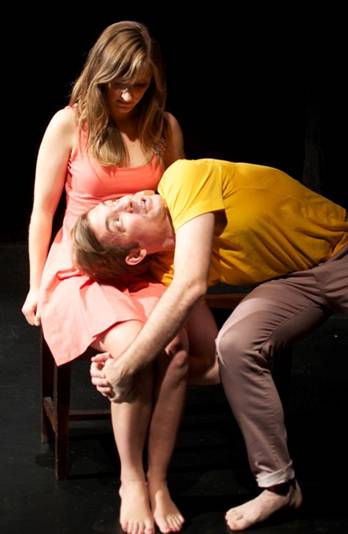
     Jamie Efros is a suitably bewildered Billy Pilgrim, confident only when reporting on the Trafalmadorian fourth dimension.  Anni Weisband embodies Montana Wildhack’s sexy attitude.  Christopher Travlos is convincing even though too young for both of his roles – the unfortunate Edgar Derby and the wise Eliot Rosewater.  Since Rachel Berger looks much better than the physical description of her Vonnegut gives, she has to persuade us through annoying behavior that her choice as Billy’s wife was an unlikely one, which she accomplishes.  Daria Tavana is the playwright; Jenny Beth Snyder is the director.  
     For complete production info: http://www.truefalsetheatre.org/blog/

Friday, August 23, 2013

Look What I Found in the Parking Lot: Richard III

Alessandro Colla as Richard; Arash Mokhtar; Sheri Graubert


This is a review of a unique experience that’s there for your taking.  It costs nothing, yet it is of great value as some Shakespearean character might say if he found it, as I did, in a parking lot.  So overlooked but so worth looking at over and over and over… like a precious gem turned over in one’s hand.
On the Lower East Side of Manhattan, in a municipal parking lot on the corner of Broome and Ludlow, Richard III set about his treacherous ascent to the throne once again.  An audience of more than 200 sat in the open air on white plastic chairs and blankets, alternately charmed, amused and disgusted by his antics, but entertained throughout for every one of the 145 minutes that the show runs.

Some stood draped over the metallic beasts that signal our modern age – cars – after all, we were in a working parking lot – and some of these beasts came and went driven by some motivation different than ours.  We were staying put to see how this drama would play out, reminded by our modern setting that the things that define an age may change, but human interactions do not, and words that capture them with such art outlast all change. 

Alessandro Colla gives us a witty, devilish, energetic Richard III.  He is as immune to remorse as Shakespeare wrote him, yet capable of assuming the attitude of the truest of penitents when it serves his purposes, while feeling none of the emotions he so aptly expresses.   Colla embodies the essential Richard, a man of action who never lets the residue of his last action dampen his next one.  His genius is the degree to which he convinces others that the destruction he visited yesterday will create a better tomorrow, even for the survivors of those he has destroyed.  Colla does all of this very well.

Much has been made in the news recently that the historical Richard III’s bones were found earlier this year under a parking lot.  Over the last 20 years, Shakespeare in the Parking Lot has given more than 50 productions of Shakespeare’s plays for more than 40,000 at Broome and Ludlow, but it was with particular delight spurred by the news that this production came about.  The audience can feel this.  Without reservation, you could say that Alessandro Colla’s performance resurrects Richard III from the parking lot.

Sheri Graubert excels as Queen Margaret.  She is the first of Richard’s victims, in actions that take place just before the start of the play, the murder of her husband, the king, and her son.  This is a performance so full of emotion and articulated outrage that it freezes you in your seat.   Ms. Graubert acts with her entire body.  Her movements and facial expressions tell the story of what she has to say so well that we do not even need the words, but the words coming out of her mouth increase the impact by infinite orders of magnitude.   She is Richard’s accuser.  She will neither bend nor break.  If Richard is reality, then she is, in Ms. Graubert’s embodiment, a protest against the way things are – primal, excruciatingly uncomfortable, compelling.
An overwhelming scene in Act IV calls to mind a famous sculpture of three sorrowful women, except these women eloquently speak their grief:  Veronica Cruz as Queen Elizabeth; Kristin Johansen as the Duchess of York; and Sheri Graubert as Queen Margaret deliver a moving, passionate, searing display of emotion which you can read on the faces of the audience as you look around, and then you remember you are in a parking lot.

You have no excuse not to park yourself there.
 

Richard III runs through August 17, Thursday, Friday, Saturday 8PM.  It is directed by Hamilton Clancy and performed by the Drilling Company.  www.drillingcompany.org.  For more information, www.shakespeareintheparkinglot.com.

Tuesday, August 20, 2013

Savage/Love


Savage/Love is not a play as much as a display of everything you already know about that thing called love, if you’ll only admit it. 

The script is a collection of improvisational poems written by Sam Shepard and Joseph Chaikin, performed by the talented De Facto Dance Company with the help of wordless tropes like musical chairs, bullfighting, ballroom dance, punch and judy, feints, mime, frozen poses, swordplay, clowning, spooning, deep embraces and the many expressions of separation.

And then there are the words.

Instead of eharmony, think edisharmony.  Put MTV’s Girlcode alongside the WWE and there you have it, honest and dishonest in the same breath or movement.  More than anything, this performance makes clear that like Kubler-Ross’s five stages of grief there are stages to love, except in Savage/Love they’re not linear, they’re shuffled, and the roles keep changing, today master, tomorrow slave.  The only impossible thing is to truly see the other.

Cirque du Soleil has a performance in which a man and woman engage high above the crowd in a spinning death-defying tightrope act and everyone in the audience who has lived recognizes in it a metaphor for the danger of relationship.  No one dies in Savage/Love, but everyone’s wounded.  It sounds solemn, but it’s also really comic and truthful.

The words conceal and reveal.  The dance expresses the attitudes of love – a constant shuttling between the intense desire to be saved from myself by love to a retreat into myself from this suddenly incomprehensible thing – love, with you.  “The murder without a weapon…”

The troupe of actors is dressed in primary colors to stress the rainbow of fundamentals they embody.  There is some multimedia, especially one notably effective moment with a scarf and a projected image.

What better to express all of this than the elusive dream of a dance? 

Savage/Love is presented by De Facto Dance and will be presented at HERE, 145 6th Ave).

Director: George Russell

Featuring: Leah Christine, Kelly Donovan, Meg Fry, Meagan Kensil, Charley Layton, Sydney Matthews, Wayne Maugans, George Russell & Jordan Smith
Original Music by Seth Clayton; Video Projections by Adam Meeks;
Lighting by Karsten Otto

Press Contact: Sydney S Matthews Sydney.S.Matthews@gmail.com| 949.702.2633

For more information, www.facebook.com/DeFactoDance

Friday, June 29, 2012

“The Music Never Stopped” tonight On Demand, movie based on a book written by neurologist Oliver Sacks tells the moving, true story of how a father and son lose and find each other through the music of the 60’s. Ever feel that certain songs preserve personal history and stop time? That’s what this film is all about in the most extreme sense.

Sunday, June 17, 2012

Mad Men Season 5: Finale

"This is what happens when you have the artistic temperament but you are not an artist."


Beautiful nuance.  Devastating sentence.  More beautiful and more devastating when delivered, as it was, with a French accent.

Thursday, June 14, 2012

Attended an engaging, intimate discussion with Jim O’Hara of Major League Baseball Productions as part of a semi-weekly series hosted by the NY Chapter of National Academy of Television Arts and Sciences  (the people behind the Emmy Awards).  Among other projects, Jim is the one primarily responsible for the Yankeeography programs we see on YES.
                    
He got his start on This Week in Baseball in the 1970’s.  He gave an interested audience the inside baseball on just about every bit of footage having to with major league baseball.  He was poetic on how clips, interviews, stills, music, and narration dissolve into a final product, and expansive on the vast reach of the MLB video archive.  He is clearly a man who enjoys his job.

Saturday, June 2, 2012

Never Let Me Go


Maybe it was the hour or the mood I happened to be in, but I stumbled upon “Never Let Me Go” late last night and I could not let go.  Narrative voice can be such a strong element.  When the voice is Carey Mulligan’s, how can you help but fall in love?  The eerie beauty of this story about a future in which some live different lives than others in the name of progress had me from the first few words.

The scene that reveals the innocence of the young man who believes that by creating a body of exceptional art that reveals our souls we can stave off the inevitable is touching, tragic and archetypal on so many levels.  I won’t forget it soon.

Still shots like these three – red barns on the hillside, trees seen from below moving in the wind, and a solitary tree at the end – complement the storyline.  

This is a strange, effective coming of age story.  It succeeds in opening our eyes at the same pace it does those of the characters.   Like any successful story it gives us the specifics of specific lives vividly, but something happens to us while we watch that makes us feel, despite the differences, that some part of our own story is being told, and this keeps our attention.

Usually when I learn from the credits that a film is based on a book, I rush to get it, but this time I’m going to wait awhile.  I can’t have my heart broken again so soon.