Wednesday, May 18, 2016

NICE T!TS

A person alone on stage, even a stand-up comedian doing a practiced routine, always elicits reflections on mortality. I think it’s just the reality of the person standing there alone telling you his or her story — which is, in the end, all we have. These undercurrents are right on the surface in “Nice T!ts” where with impeccable comedic timing this story of loss and rejuvenation is told with visceral empathy by playwright/performer, Amy Marcs. 
This is her story. But she does something I have rarely, if ever, seen before. At times, she empathizes with us empathizing with her, almost as if to say ever so briefly with a pause or a gesture or a phrase, “Yeah, this is what happened can you believe it and I’m here telling it to you.” She has a curiously sophisticated rapport with the audience that grows in impact when you consider that some of those sitting in the dark have been drawn to the show by experiences similar to hers.
Breasts themselves are characters in this one-woman show. We can’t help but be reminded, whatever our gender, that these were our first objects. We can’t deny their iconic meaning, their societal and economic value, how they can make things happen. This is humorously driven home by none other than the voice and image of Barbie, the plastic surgeon of our attitudes.
But on the serious side, these primary objects mysteriously become primary to the subjectivity of some of us. Then to have that part of your identity “ripped away” in the words of one of the cancer center voices Amy Marcs impersonates can only be devastating.
This is how well-told stories work. The women in the audience immediately identify, whatever their experience. At first, the men are transformed into even more distant spectators, as if we weren’t already completely in the dark about what women are all about, but then Amy brings us all back, because this is a universal story about the losses that challenge our identity, which is not gender specific, because none of us is immune to events and the passage of time.
She does this with humanity and humor, just what the doctor prescribed.
One more chance to see Nice T!ts: May 19, 8:00PM.  See below for details,
NICE T!TS
Written and performed by Amy Marcs; directed by Peter Michael Marino; incidental music, Michael Bradley; associate producer, Sara Krieger; technical director; Christine Pynn; sound recording, Roy Renza; stage manager, Courtney Fostvedt; hair and make-up artists, Cassidy Horn; dance break, Tyler Lee; graphic designer, Wendy Lui; personal assistant, Ellen Ball.
At The PIT LOFT – 154 W. 29th St (b/t 6th & 7th, New York City); 212-244-1722.  ONE MORE SHOW, May 19, 8:00PM.

Thursday, July 23, 2015

U Juornu Avanti - "The Day Before"

Countless Americans owe the good fortune of their daily lives to a decision someone else made decades ago – but how many can even begin to understand the courage and the anguish involved in taking that step?  Here is a short film that will make it all real for you. 

U Juornu Avanti (“The Day Before”) is a Sicilian language film with English subtitles which dramatizes a single day in the life of one man – the day before he leaves Sicily for America. With the promise of a better life ringing in his ears, Minicu makes tearful good-byes to his two brothers and his mother, who has sold her earrings to buy him clothes.  He vows to send back enough dollars that she can buy as many new ones as she wishes.

He says good-bye to his friends, asking them to watch over his family, and takes leave of his intended with the promise to return.  He gets cautionary advice from those who have already crossed the ocean and from those who simply draw it from their hearts.

Twin visual images – the beauty of the landscape where fog spills through the mountaintops like the rich, complicated, ancient history of Sicily itself and the striking expressions on the faces of its people deepen the experience for the viewer and make it more meaningful.


If you are the son or daughter of immigrants from any part of the world, consider whether any decision of yours has had as much impact on your life as the one made on the day your ancestors stepped onto a boat bound for America.  You owe it to them and yourself to understand as much as possible about their thinking and their emotions.  Un Juornu Avanti is a film that will get you there. 

Get your copy of the film by supporting the efforts of the young filmmakers who have done a miraculous job putting it together.  Visit this page  http://bit.ly/1HUg0XR

Friday, June 19, 2015

Blues by the Beach, Cinemonde #49

The beauty of the young girl – her smile, the freckles beneath her eyes, her French accent.  This is what stays with us.  It’s always impossible to separate the appeal of beauty from its evanescence, but to have it torn away so abruptly, where is the lesson? 


Blues by the Beach is about the loss of innocence.  If innocence is music and dancing and laughter then that is what countless patrons, an eclectic, global crowd, found in a Tel Aviv pub called Mike’s Place until the night was shattered by a terrorist bomb. 
 
Blues by the Beach is an accidental documentary.  Jack Baxter came to Israel from the Bronx intending to do one documentary, got sent in a second direction, and ended up with something completely unexpected and revealing.  He stood before the audience and explained this, leaning on a cane, his constant companion since the blast injured 50 and killed three, including the French waitress with the smile.

This screening was one of Cinemonde’s unique evening productions, #49 to be exact.  It took place in the penthouse of the Roger Smith Hotel on Lexington Avenue.   Glasses of wine and hors d’oeuvres shared by an enthusiastic group of select moviegoers led up to the viewing.  Afterwards, the publisher and the artist of a graphic novel called Mike’s Place that re-tells the story in the movie answered questions for an audience that included the doctor whose quick work saved lives at the scene.

The publisher told us that he had chosen the project because of the three love stories it tells.  The artist told us something about his process that involved 1,000 drawings that took a year to complete and about what kinds of slight changes to a script the graphic novel format occasions.  The owner of the bar towards the end of the film tells us how the bomb shattered more than physical things that could be repaired – that relationships ended.  The publisher reminded us that one of those relationships was still intact, even stronger.  Events have consequences; the filmmaker walks with a cane.

Graham Greene comes to mind, superficially because “The Third Man” is the best example of a novel appearing after the movie.  But more than that, Greene’s central characters always arrive in a foreign place and bear witness.   Jack Baxter even sounds like a name out of a Graham Greene novel.   For me, Blues on the Beach drives home more viscerally than any other film of its type the documentary camera as witness that turns all of us into witnesses.


Cinemonde is the brainchild of Jerry Rudes, a consummate showman with something substantial to show.  It calls itself “a smart, elegant private film series in New York City” to which, after one experience, I can attest.  It is produced by Rudes' company, Mistral Artist Management, aptly named for the strong wind that blows across southern France with positive, lasting effects on the climate of the region.  The next time a Cinemonde invitation pops into your email inbox, consider going.  It’s well worth it.

Monday, May 25, 2015

Taddrarite ("Hidden Women") InScena Italian Play Festival

Was I in the wrong place?  I came to see a play, but all I heard as I approached the darkened
room in this ornate building was crying -- inconsolable sobbing. As I entered the room, one of the crying women looked into my eyes like the closest of friends, increasing my doubt.  And then another pointed me to a row of chairs before a closed wooden coffin with a large cross on its cover.  


We soon learned that the acting had begun with the first tear.  And that there were two audiences for those tears -- us and the invisible, now departed neighbors and relatives at this solemn wake whose parts we had just played without realizing it.  And now, it was our turn to become invisible in this empty room where three sisters dressed in black sat on chairs facing the coffin.

This staging is one more example of the inventiveness of InScena, the annual Italian Play Festival that takes place in the five boroughs of New York City, and of Laura Caparrotti, its founding artistic director.  The play is Taddrarite ("Hidden Women" English title), winner of 2014 Rome Fringe Festival.  InScena has finished its run for this year but will return in 2016.

The tears in this play are real, but they are not for the dead man in the coffin.  Rather, they are for the lives of the three sisters, who have suffered physical and emotional abuse at the hands of their husbands. For the men in their lives they have only sarcasm and scorn, delivered before us with humor and passion.  Together, they pray "the false rosary" to our amusement but we get the serious message.

It's not only that things like what they recount have happened to them, but how the shroud of silence, aided by the women themselves, has all but institution out of the behavior.   But this is their breakout moment.  As one of the sister confides: "Silence is the key that closes every door." But this play speaks loudly.

Written by: Luana Rondinelli

The sisters played with passion and humor by the fiery Claudia Gusmano (who won the best actress in 2014 Rome Fringe Festival), Luana Rondinelli, and Anna Clara Giamponi

Performed in Italian with English supertitles

Saturday, September 20, 2014

IN SCENA: Via dei Capocci

July 4,2014

What is a street in New York if not theater? And when you are on the way to a play named after a street that has earned a certain reputation the play begins before the play, surrounded as you are by characters playing themselves, high-heeled, rouged up, tattooed, the junky embracing the fire hydrant, the swank chick pushing the double stroller, the businessman with his briefcase, the man walking the dog, several men walking several dogs.  Theater for the New City is just off St. Mark’s Place. Need I say more?

It was the perfect setting for the final evening of In Scena! -- the two-week festival dedicated to bringing Italian theater to the streets of New York. When artistic director Laura Caparrotti, who had been enticing us throughout the festival with descriptions of things about to happen and things yet to come, turned up as the weary but lively former madam in the play, there was poetry in this.

It did not take long to see why Carlotta Corradi’s play had won the festival’s first Mario Fratti Award for emerging Italian authors.  In fact, I heard someone in the audience behind me say those exact words during the first exchange between the madam and Ira, the foreign girl who has answered the call for someone to clean up the house. Of course Ira has a past not unlike the madam’s; they are both finished with that life; but they are also entirely different personalities, evidenced by the fact that the older woman is now making her living by lending money at high interest and the young girl is looking for houses to clean.

Everyone has a past.  Through interludes, this play shows us the past and the present, and how the past meets the present.  This is Europe post WWII.  Everyone has suffered.  The war’s biggest victim is innocence itself, yet innocence persists, even in the older madam, an atheist who constantly talks to God, a disappointing and disappointed mother who may just have found a true daughter not of her own blood who she christens with a simple white flower.  On the streets of New York, we would call this tough love.

Carlotta Corradi has found a real street in Rome with a real past and out of it she has created an imaginative, compelling conversation that you should hear. Laura Caparotti is Lina, the convincing older madam whose vulnerability, deeply buried, has been awakened by Giulia Bisinella as Ira, the embodiment of innocence itself.  Ms. Bisinella’s portrayal of her character is so instinctual and thorough that it has a cleansing effect on the audience.  The conversation between these two actresses is like a dance.

Carlotta Brentan and Jojo Karlin, also characters with very different personalities, show us the past and then link to the present in a way that deepens the meaning of the play.  Kudos to the versatile Ms. Brentan who in addition to acting and serving as executive producer of the festival, also translated Ms. Corradi’s script into English.

---------------------------------------------------------------------------------
Kairos Italy Theater, the preeminent Italian theater company in NYC, presented its second In Scena! Italian Theater Festival (www.inscenany.com <http://www.inscenany.com/>) in all five boroughs from June 9 to 24, 2014.  The event featured six full productions and four readings.   “Via dei Capocci” is winner of the first Mario Fratti Award for Emerging Italian Playwrights, an honor created and bestowed by the In Scena! Italian Theater Festival.   

IN SCENA: Fallaci, a Woman Against


June 19, 2014

In a sense, a reading is a greater test of a script than a full-fledged play, precisely because in a reading all you have are the words.  But what could be more appropriate for a figure as invested in words as Oriana Fallaci?   She is the subject of “Fallaci, a Woman Against,” one more performance in the eclectic two-week run (June 9 -24) of In Scena, the Italian Theater Festival taking place in all five boroughs of NYC.  Go here for the calendar:   

I hesitate to call her a journalist because she so completely rejected that characterization. 
Hear that rejection in her own words convincingly delivered by actress Andrus Nichols whose portfolio of characters includes another strong woman – Bernard Shaw’s Saint Joan.  

Instead of journalist, the writer’s words in the mouth of the actress carefully explain that the moniker she prefers is historian in the moment.  She imagines interviewing historical figures like Joan, Caesar, and Napoleon with the same intensity, challenge and distrust she applied to Henry Kissinger, Golda Meir, Willy Brandt, Nguyen Van Thieu, Ayotollah Khomeini and other elusive, prominent figures of her day. 

Imagination and poetry are at the heart of this production.  Playwright Emilia Costantini has weaved Fallaci’s own words together to create an interview that never took place.  Two women sit on chairs facing each other, interviewer and interviewee, exactly the kind of free-ranging discussion of herself Fallaci never agreed to in life.

The poetry is in the depth of the subject matter and artfulness of the words that make up Fallaci’s responses.  She will tell us that writing is the most strenuous job in the world and that only written words have lasting value, that disobedience to the arrogant is mandatory – the only justification for the miracle of being born, if we do not protest injustice we are like leaves dragged in the wind, that war is the bane of human existence, that politics as a career is destructive to the world, that love is unknowable, that there is no reality like the death of a mother because it anticipates your own.  She is a professed atheist, an eloquent spokesman for the soul, a woman at one with and against the history of her times.

All of this comes through.
-----------------------------------------------------------------------

Written by Emilia Costantini
translated and adapted by Dave Johnson and Laura Caparrotti with help from Carlotta Brentan


Fallaci played by Andrus Nichols    Full In Scena Calendar:  http://www.inscenany.com/

IN SCENA: Hanno tutti ragione – Everybody’s Right

June 14, 2014

If you’re ready for something entirely different or if you’re naturally drawn to things Italian – and who isn’t?  – mark your calendar for the In Scena Italian Theater Festival, beginning with this unique play.  The festival runs in all five NYC boroughs through June 24. Go here for the calendar:  http://www.inscenany.com/ 

This is a play based upon a novel written by an award-winning movie director, Paolo Sorrentino.  The novel is nearly 400 pages long; the play is less than 5,000 words delivered by a woman playing a man, animating the dialogue impeccably with dance, gestures and song.   Every spoken word is in Italian but that is absolutely no barrier for non-speakers thanks not only to the English super-titles that display above the action but also to the richness of the delivery.  If anything, this play is a tutorial in how much more than words there is to a meaningful performance.

Tony Pagoda, lounge singer, world-weary like all of Sorrentino’s characters, regardless of the medium, is about to experience what should be one of the highlights of his career – a performance at Radio City Music Hall where none other than Frank Sinatra will be staring back at him from the audience.

Iaia Forte, the actress who played Trumeau in Sorrentino’s Oscar-winning “The Great Beauty” (La Grande Bellezza) rivets your attention as Tony.  Only one other character intermittently appears on stage – a woman with whom Tony dances provocatively.

Life is a song.  Life is a dance.  Tony may not be at the end – the music is still playing – but he’s definitely past the middle.  He’s stuck in that moment that seems to fascinate Sorrentino – when his characters can no longer escape the conclusion that the promise of abundance has failed.  Tony is disenchanted with the world, but he cannot claim innocence, none of us can.  

Tony Pagoda is past the point of fixing anything.  He can only be eloquent about the place to which he has arrived.  This eloquence Iaia Forte embodies for us.  In the telling, she makes us forget that she is a woman playing a man, or that she is speaking a language that may not be our first.  As Tony, she rails against all of those things that disgust him; Tony finally tells us he only likes “nuance.”  Iaia Forte gives us nuance.

I do see in all of Sorrentino’s work a flicker of hope – circumstances do not change, nothing develops except the possibility of understanding.  For Tony what flickers is one word – a name with reverberations in the literature of his homeland – Beatrice.

The In Scena Theater Festival is like an Italian feast made up of endless courses.  That’s what I felt when Executive Producer Carlotta Brentan enthusiastically outlined for me the week’s lineup, like a master chef lavishly describing the specials on the menu.  I have my eyes on three tempting dishes.  Buon Appetito!
-------------------------------------------------------

Once again, the full In Scena calendar:  http://www.inscenany.com/
Hanno tutti ragione – Everybody’s right
Based on the novel by Paolo Sorrentino
Tony Pagoda aka Tony. P – Iaia Forte

Director Tony Servillo

Thursday, September 18, 2014

HUMAN FRUIT BOWL


March 30, 2014

This play is a spoken meditation on so many things – art, subjects, objects, knowing, not knowing, thinking that we know when we really don’t – heady stuff – embodied throughout in the quiddity of the naked, young girl standing before us.

Let’s admit we can’t take our eyes off her.  But we also can’t stop listening to her.

This is a unique experience.  When before have playgoers been offered pencil, paper and a lapboard so they can draw what they see?   (The image at the top of this review is a snapshot of a sketch that the woman sitting next to me kindly let me take). 
 
The audience transforms into a live drawing class with an “inside view” that no live drawing class ever gets – the inner life of the model.  

Take a string of things – a heterogeneous parade through the mind – errands she has to do today, the next pose, artists we think we know, models we don’t know except for their names, why is that, famous, infamous, smells, stories, sights, sounds – and the fragmentary return of a rumor of suicide – like a tune that keeps coming back each time in a slightly different key -- when did it happen, why did it happen, how did it happen, did it even happen?

This is what transpires when the subject is an object with its own subjectivity and we dare to explore it.  Distinctions blur.  The play’s multimedia production holds up for our reflection paintings as special objects worthy of a museum because this many years later they emanate with the energy of their little known subjects.

Human Fruit Bowl is a well-conceived, well-written, well-acted experience.  It’s more than a play.  It’s an education.

Bravo playwright Andrea Kuchlewska!  Bravo director Jessi D. Hill! Bravo actress Harmony Stempel for a brave, compelling performance – you turned us inside out.  

--------------------------------------------------------------

Baruch Performing Arts Center in association with terraNOVA Collective & soloNOVA Arts
The Rose Nagelberg Theater at Baruch
55 Lexington Ave. at 25th Street
Performances Thurs, Fri 8PM; Sat, Sun 3PM, thru April 11

TICKETS:  email ron@spincyclenyc.com or CALL 212-505-1700 x. 11

LUCKY ME


August 11, 2014 

“Lucky me,” I was thinking to myself once again as I sat in the NJ Repertory Theatre in Long Branch, because this theatre is such a find.  Twenty minutes before show time were enough to quietly marvel at the set – a seemingly fully-functional kitchen, a dead ringer for the ones audience members may have just left on their way to a play about to start.  It reminded me how much and varied artistry it takes to bring the mere words of a script to life which must be why they call it – a production.

As it turns out, in “Lucky Me” the set plays a major part.

“Lucky me,” I was thinking to myself once again as I sat in the NJ Repertory Theatre in Long Branch, because this theatre is such a find.  Twenty minutes before show time were enough to quietly marvel at the set – a seemingly fully-functional kitchen, a dead ringer for the ones audience members may have just left on their way to a play about to start.  It reminded me how much and varied artistry it takes to bring the mere words of a script to life which must be why they call it – a production.
As it turns out, in “Lucky Me” the set plays a major part.

So do the actors, of course, with a dyspeptic, comedic Dan Grimaldi at the center of the action playing the part of Leo, by turns predictable and unpredictable, but always excruciatingly entertaining.  He fills us with doubt – about whether he actually perceives the things he says he does and about whether he’s actually devoid of the sense he acts as if he doesn’t have.  He delivers that rare level of acting that makes a script even more interesting than it may be.   Not only is the actor acting but so may be the character he portrays.  This keeps the audience on its toes and moves the action along.

Wendy Peace as Sara is also hiding something.  She’s made her peace with events we witness bordering upon the comically supernatural, which is where the set comes into play.  But there is also a bigger reality she is not talking about, which may explain her very convincing hesitancy about well… everything, including Michael Irvin Pollard as Tom, smitten and persistent, in spite of everything.  He is the only character in the play without a sense of foreboding.  We wonder whether his job as a TSA Agent has inured him to worrisome signals, which gives us a sense of foreboding for our own lives outside of the theatre, if he’s typical. 

Mark Light-Orr as Yuri, the young landlord, gives dimension to what in other hands would be a one-dimensional role.  We like him and we like his accent, and we’re thankful to him for helping to unravel the mystery in such dramatic fashion.
 
Fireworks, failing lights, and an unbelievably realistic rainstorm make us bow to set designer Jessica Parks, lighting designer Jill Nagle and sound designer  Merek Royce Press. 

Director SuzAnne Barabas draws impressive performances from an excellent cast.  The interaction between the actors carries the day.  I’ve also resolved to arrive 20 minutes early for every upcoming performance to let the set begin the play before the play begins.
------------------------------------------------------------------
Show runs through August 31.  Performances: Thursdays, Fridays at 8pm; Saturdays at 3pm & 8pm; Sundays at 2pm and selected Sundays at 7pm. 
Written by Robert Caisley; Directed by Suz Anne Barabas.
Cast: Dan Grimaldi as Leo; Mark Light-Orr as Yuri; Wendy Peace as Sara; Michael Irvin Pollard as Tom.
Set Design by Jessica Parks, Lighting Design by Jill Nagle, Sound Design by Merek Royce Press,
Costume Design by Patricia E. Doherty, Properties by Jessica Parks, Technical Director, Michael "Rusty" Carroll, Stage Manager, Jennifer Tardibuono    

Wednesday, September 17, 2014

A VIEW of the MOUNTAINS


April 30, 2014

Count your blessings.  That’s what audiences at playwright Lee Blessing’s “A View of the Mountains” can do through April 26 at the New Jersey Repertory Company in Long Branch.  So can all the residents in surrounding areas – to have such a theatre within reach.  Once again, the set, the acting, the direction, the intimacy achieved between audience and performers reach a level of excellence that begins with the choice of material.  “The play’s the thing,” and for that, we need to thank Mr. Blessing.

A number of years ago I saw his “Cobb” off-Broadway in NYC where the three characters on stage were the infamous hall-of-fame baseball player at three different stages in his life.  They argued, taunted, questioned each other and tried to explain themselves as any of us who has lived more than a few years does within ourselves nearly every day.   This innovative staging of character made an impression that has never left me.  In “A View of the Mountains,” the debate is just as familiar, because it echoes the current national political polarization and the ageless conflict between father and son.

The action is very quick.  This is a compliment to all involved when you remember that the substance out of which the story emerges is made up of only words.  This is the art of theatre at its best, and for some reason that seems to get communicated more thoroughly in confines this small in size.

“A View of the Mountains” is a sequel to “A Walk in the Woods,” Mr. Blessing’s earlier play about a US arms negotiator and his Russian counterpart.   Thirty years later, we encounter that arms negotiator in his comfortable home on the Hudson anticipating an uncomfortable visit from his son, the junior senator from Tennessee, radically different from his father in political ideology.

What transpires is the acting out of differences within a family – memories, anger, disappointment, comedy – physical comedy – and the revelation of secrets…

Eva Kaminsky embodies the role of Gwynn, the senator’s wife.  She’s comic in the extreme, energetic, highly expressive, single-minded, an audience magnet.   John Little as the arms negotiator is reflective and strategic; he gives us a man with experience.  Katrina Ferguson as the negotiator’s wife strikes the right ironic balance; a late entrant into this family drama, she is alternately amazed and amused.  Michael Zlabinger as “Will” has very little will; he convincingly shows us someone under the influence of external circumstances and forces, including his own wife.  The teenage son of the arms negotiator and Ilsa, half-brother to Will, is played with complete familiarity by Jon Erik Nielsen or Jared Rush in different performances.
---------------------------------------------------------------
Directed by Evan Bergman; set design Jessica Parks; lighting design Jill Nagle; costume design Patricia E. Doherty; properties Jessica Parks; technical director Michael “Rusty” Carroll; stage manager Jennifer Tardibuono; fight director Brad Lemons.

Performances through April 26:  Thursdays, Fridays at 8pm; Saturdays at 3pm & 8pm; Sundays at 2pm and selected Sundays at 7pm.  New Jersey Repertory Company; 179 Broadway, Long Branch, NJ 07740 (732) 229-3166  http://www.njrep.org/

Tuesday, September 17, 2013

Yankee Wives


   Okay, I admit it.  Right up until the start of the play I was checking my cell phone for the score of the game.  Yankees-Red Sox in a year when New York needs every win it can get to stay in the race makes for drama.   Earlier in the week it had occurred to me how much the last month of the season to a baseball fan whose team is in the run resembles one of those hit series that have taken over television where fans tune in because they must see what happens next.    Until this play, I’ve never really thought about the wives of the players.
     I was about to be introduced to five women, and then a sixth.   I don’t think I’ve seen many productions of any kind in which the entire cast is of one sex, except maybe for POW films where an escape is being planned.   The only male presence for the next few hours would be the disembodied voice of the announcer – unreal and distant from the action happening between and among the women, as distant as their offstage husbands.
     I say “between and among” because conflicts happened to pairs and then the group reacted, just like in real life.  There are secrets but nothing stays secret for long, just like in real life, and there is a transformation that takes place.   I’m not being flip when I say that changes in hairstyle signaled that a change had happened to the character on the inside.
     The play takes place in a locker room, which is metaphorical, at least more metaphorical than the seating section for wives in the stands.  
     The sixth woman who stepped on the stage, the rookie wife, Wyla, played by Eliza Simpson, stole the show for me.  To be fair to the others, all excellent in their roles, her character is written to do that.    Their historical conflicts, their hierarchy, their way of interacting for what we fell is years set the stage for her arrival.
She is awkward, innocent to a point, untutored, easily awestruck and absolutely genuine.   She completely embraces the role.  She handles the comedy very well.  The best compliment I can give is that you instantly feel that that you know her.
     Samantha Strelitz as Pam, the Olympic swimmer with a record of athletic success all her own but whose husband can’t hit the curveball, conveys well that combination of paradoxes that makes up a real person.  To say more would be to give way too much. 
     Chudney Sykes, as Marceline, wears well the trappings of her role – she is the wise one, mature, forgiving, always steady.   Jennifer Laine Williams as Sally is the convincing Queen of the locker room, disciplinarian, keeper of the faith, will she ever see another way?   Cristina Marie and McKenna Fox as the duo of Connie and Ronnie anchor the action with a comedic, matter-of-fact routine.
     “I wish every woman could have a baseball card of her husband,” says the rookie wife early in the play.  By the end of the action, you might conclude that the women have come into their own… maybe the husbands should have baseball cards of their wives.
     At intermission, when I checked my phone, I was distressed to see that the Red Sox had a 4-2 lead.  At the end of the play, I walked briskly from 26th Street to Penn Station, troubled that the score was now 7-2.   Thirty minutes early for the next train, I sought out the bar where I watched, hope against hope, the home team roar back to a 7-7 tie.   
Sitting in the train, moving in and out of the tunnels, gaining and losing connection, my cell phone told me that we were ahead 8-7, then that it was tied 8-8. 
Arriving in my town, I walked to the bar near the station and watched the final unraveling, only me and the bartender.  He was pessimistic about our chances and he was right.  We lost 9-8, a heart-breaker.
    “I’d better go,” I said to him.  “I have a review to write.”

Play runs through 9/15.  Hudson Guild Theatre, 441 West 26th Street. More info www.yankeewives.com

Playwright/Director David Rimmer. Set design by Allison McGrath, Lighting design by Ian Edward Smith. Costume design by Ramona Ponce. Sound design by Matthew P. Morris. Fight choreography by Dan Renkin. Produced by Group Theater Too.

Monday, September 16, 2013

Einstein

This is a play about history, science, philosophy, obscurity, celebrity, but mostly about change, the kind of revolutionary change that defined the modern world for better and worse, and how it sprang from the imagination of a single man. 
     Richard Kent Green is an excellent Einstein.  He is the only actor who does not play more than one part in this performance.  In a subliminal way this reinforces our focus on him as a singular figure at the center of his own self-conscious history; around him other people swirl, come into existence and disappear; they are the actors in his life.
     In 1962, Thomas Khun wrote a book called “The Structure of Scientific Revolutions.” It would be considered an important book if it had done no more than plant the meaning of one word in our minds – paradigm.  
     There are changes all the time but only extremely rarely is there a change in paradigm, an entirely new, more accurate explanation of reality.  Einstein’s discoveries, conducted in the laboratory of his mind, changed the paradigm. 
     The play opens with Einstein sitting on a park bench, wishing he could have a conversation with Newton, centuries his predecessor.   Instead he gets his good friend Besso, who appears out of nowhere, wearing a straw hat and holding a cane, sunny in disposition, chaplinesque in his movements.  He cares about Einstein.  One off-handed comment transforms Besso into an accidental muse, giving Einstein the kind of insight he might have hoped for from Newton.
     The choreography is subtle and impressive.  Ideas dance in and out of Einstein’s mind.  Conversations among three people about a fourth who stands silently by, outside of the action, are overheard by this person we can tell from his or her facial expression.   It is an effective way to get across that conversations people have about us will eventually reach us, if not the actual words, then the feelings they express.
     Even more impressive, is the moving image of what it means to become famous, sparingly and beautifully rendered.  An Einstein solitary in his thought until his theory wins popular attention, is suddenly set upon by a flock of reporters who swarm around him like pigeons.  He drops the bread crumbs of a few words, an answer to a question, then moves downstage and they reassemble around him, the center of their temporary universe.
The lighting is also to be complimented, and the venue, a theatre within a church – what better for an exposition on such fundamental subjects – the structure of the universe, light, matter, energy.
     Grant Kretchik who plays Besso demonstrates admirable range when we meet him later as the atomic scientist Neils Bohr, urging a reluctant and ultimately uncooperative Einstein to address a gathering of younger physicists who look up to him.  His own theories have led them in a direction he finds unpalatable – quantum mechanics – which crudely described posits a different structure at the atomic level than is evident thanks also to Einstein’s theories in the large-scale universe.  Einstein will have none of this or the uncertainty principle on which it is based.  For Einstein, if a theory is probabilistic that is because the answer has not been found.  He stubbornly persists in his search for a unified theory, as he will until his death.  Repeatedly, he will reject the work of others.
     This is not a play just about science.  It’s about a human being at a certain point in history; as much as it is about the changes he effected, it is also about things that he could not change, and about irony.
     The irony is that Einstein, the man, while expressing great empathy and love for humankind could, by his own admission, not love individual human begins.  He felt passion only for science and causes.  He is also caught up in history – the persecutions of Nazi Germany and McCarthyism; the fateful letter to Roosevelt that saves the western democracies but unleashes the possibility of what he calls a chain reaction of death, his Faustian bargain, a pacifist, father of the atomic bomb.
     All of this is here and much more as the years projected above the action unfold – 1905, 1919, 1927, 1932, 1942, 1945, 1955.
     The actors are all remarkable.  They reappear creatively in new parts to the delight of the audience, demonstrating their skills and advancing the story. Take Jill Catherine Durso who plays the mistreated Mileva, Einstein’s first wife, whose work on the mathematics of his early theory went forever unrecognized, the mother of his first daughter in whom Einstein expressed no interest, maligned as below him by his parents, cheated on by him as will be his wont throughout the play, also with his second wife – this actress not only plays Mileva, but the women with whom he has dalliance, an interesting concept.
     If you have an interest in Einstein, history, science, imagination, humanity, modernity, human failings, genius, or how great acting can bring  all of this to life, see this play.  I can’t help but end with a paraphrase of my favorite Einstein quote, even though it is not in the play:  “I don’t know which weapons will be used to fight World War III, but World War IV will be fought with sticks and stones.” 

Slaughterhouse Five: the Play

This is a brave attempt to do the near impossible – and it succeeds in what audiences appreciate most – humor.   
      But Vonnegut’s humor is of the darkest variety, and getting across that darkness and still getting people to laugh at it is not so easy, especially in a play, where for the most part your only tools are words.  Slaughterhouse Five, the novel, has always seemed to me like a 200-page thesis on two lines of poetry from Byron:  “If I laugh at any mortal thing, ‘Tis that I may not weep.”  Billy Pilgrim, the central character, weeps often, and alone.  It’s one of two things he does alone; the other is time-travel.
      Let’s not forget that the venue for this play is a theatre at 21 Clinton Street in Lower Manhattan with the name “Celebration of Whimsy.”   This play focuses on the whimsy of time travel.  The humor spills out of the sudden shifts of venue, sometimes kept secret from the other characters in the play, which elicits laughter.    This is the story of Slaughterhouse Five told from the viewpoint of the Trafalmadorians , inhabitants of Billy Pilgrim’s other-worldly destination, who believe that everything is how it is and how it will always be.  The Trafalmadorian character in the play is a disembodied, voice beautifully rendered by Lena Hudson.  The audience broke into laughter often.
     Before seeing this play, I re-read Slaughterhouse Five and watched the movie once again.  What struck me is its thorough relevance to today, as if in handing us the book Vonnegut conveys one of Billy Pilgrim’s “memories of the future.”   The Trafalmadorians explain that war has always been with us and always will be… but that’s at a distance from earth, as Vonnegut tells us, of 446,120,000,000,000,000 miles.  Up close, it doesn’t seem so natural.  This number of miles may approximate the distance between those who experience it first-hand and those who never do. 
      In an interview on the director’s cut of McCabe and Mrs. Miller, Robert Altman waxes on about some of the differences between a play and movie.  In a movie you can just shift the scene; you can burn down a building to change the action as he does in that film.  David Mamet in On Directing Film tells us that the best films tell a story through a series of images, like those in a dream, like Billy Pilgrim’s flash-backs (today we call it PSTD).  Slaughterhouse Five, the movie, shows us a bombed-out Dresden, reduced to flames and rubble.   It shows us piles of dead bodies deliberately torched by soldiers with flamethrowers because there are too many to bury, and it is the only practical thing to do.  The book gives us these vivid images, too.  Not so easy in a play.  So we get lots of humor without all the horror.  So it goes. 
     Jamie Efros is a suitably bewildered Billy Pilgrim, confident only when reporting on the Trafalmadorian fourth dimension.  Anni Weisband embodies Montana Wildhack’s sexy attitude.  Christopher Travlos is convincing even though too young for both of his roles – the unfortunate Edgar Derby and the wise Eliot Rosewater.  Since Rachel Berger looks much better than the physical description of her Vonnegut gives, she has to persuade us through annoying behavior that her choice as Billy’s wife was an unlikely one, which she accomplishes.  Daria Tavana is the playwright; Jenny Beth Snyder is the director.  
     For complete production info: http://www.truefalsetheatre.org/blog/

Friday, August 23, 2013

Look What I Found in the Parking Lot: Richard III

Alessandro Colla as Richard; Arash Mokhtar; Sheri Graubert


This is a review of a unique experience that’s there for your taking.  It costs nothing, yet it is of great value as some Shakespearean character might say if he found it, as I did, in a parking lot.  So overlooked but so worth looking at over and over and over… like a precious gem turned over in one’s hand.
On the Lower East Side of Manhattan, in a municipal parking lot on the corner of Broome and Ludlow, Richard III set about his treacherous ascent to the throne once again.  An audience of more than 200 sat in the open air on white plastic chairs and blankets, alternately charmed, amused and disgusted by his antics, but entertained throughout for every one of the 145 minutes that the show runs.

Some stood draped over the metallic beasts that signal our modern age – cars – after all, we were in a working parking lot – and some of these beasts came and went driven by some motivation different than ours.  We were staying put to see how this drama would play out, reminded by our modern setting that the things that define an age may change, but human interactions do not, and words that capture them with such art outlast all change. 

Alessandro Colla gives us a witty, devilish, energetic Richard III.  He is as immune to remorse as Shakespeare wrote him, yet capable of assuming the attitude of the truest of penitents when it serves his purposes, while feeling none of the emotions he so aptly expresses.   Colla embodies the essential Richard, a man of action who never lets the residue of his last action dampen his next one.  His genius is the degree to which he convinces others that the destruction he visited yesterday will create a better tomorrow, even for the survivors of those he has destroyed.  Colla does all of this very well.

Much has been made in the news recently that the historical Richard III’s bones were found earlier this year under a parking lot.  Over the last 20 years, Shakespeare in the Parking Lot has given more than 50 productions of Shakespeare’s plays for more than 40,000 at Broome and Ludlow, but it was with particular delight spurred by the news that this production came about.  The audience can feel this.  Without reservation, you could say that Alessandro Colla’s performance resurrects Richard III from the parking lot.

Sheri Graubert excels as Queen Margaret.  She is the first of Richard’s victims, in actions that take place just before the start of the play, the murder of her husband, the king, and her son.  This is a performance so full of emotion and articulated outrage that it freezes you in your seat.   Ms. Graubert acts with her entire body.  Her movements and facial expressions tell the story of what she has to say so well that we do not even need the words, but the words coming out of her mouth increase the impact by infinite orders of magnitude.   She is Richard’s accuser.  She will neither bend nor break.  If Richard is reality, then she is, in Ms. Graubert’s embodiment, a protest against the way things are – primal, excruciatingly uncomfortable, compelling.
An overwhelming scene in Act IV calls to mind a famous sculpture of three sorrowful women, except these women eloquently speak their grief:  Veronica Cruz as Queen Elizabeth; Kristin Johansen as the Duchess of York; and Sheri Graubert as Queen Margaret deliver a moving, passionate, searing display of emotion which you can read on the faces of the audience as you look around, and then you remember you are in a parking lot.

You have no excuse not to park yourself there.
 

Richard III runs through August 17, Thursday, Friday, Saturday 8PM.  It is directed by Hamilton Clancy and performed by the Drilling Company.  www.drillingcompany.org.  For more information, www.shakespeareintheparkinglot.com.

Tuesday, August 20, 2013

Savage/Love


Savage/Love is not a play as much as a display of everything you already know about that thing called love, if you’ll only admit it. 

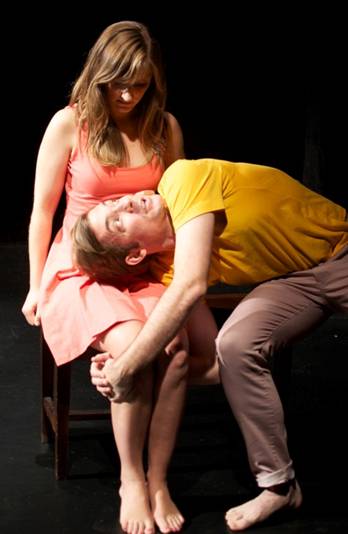
The script is a collection of improvisational poems written by Sam Shepard and Joseph Chaikin, performed by the talented De Facto Dance Company with the help of wordless tropes like musical chairs, bullfighting, ballroom dance, punch and judy, feints, mime, frozen poses, swordplay, clowning, spooning, deep embraces and the many expressions of separation.

And then there are the words.

Instead of eharmony, think edisharmony.  Put MTV’s Girlcode alongside the WWE and there you have it, honest and dishonest in the same breath or movement.  More than anything, this performance makes clear that like Kubler-Ross’s five stages of grief there are stages to love, except in Savage/Love they’re not linear, they’re shuffled, and the roles keep changing, today master, tomorrow slave.  The only impossible thing is to truly see the other.

Cirque du Soleil has a performance in which a man and woman engage high above the crowd in a spinning death-defying tightrope act and everyone in the audience who has lived recognizes in it a metaphor for the danger of relationship.  No one dies in Savage/Love, but everyone’s wounded.  It sounds solemn, but it’s also really comic and truthful.

The words conceal and reveal.  The dance expresses the attitudes of love – a constant shuttling between the intense desire to be saved from myself by love to a retreat into myself from this suddenly incomprehensible thing – love, with you.  “The murder without a weapon…”

The troupe of actors is dressed in primary colors to stress the rainbow of fundamentals they embody.  There is some multimedia, especially one notably effective moment with a scarf and a projected image.

What better to express all of this than the elusive dream of a dance? 

Savage/Love is presented by De Facto Dance and will be presented at HERE, 145 6th Ave).

Director: George Russell

Featuring: Leah Christine, Kelly Donovan, Meg Fry, Meagan Kensil, Charley Layton, Sydney Matthews, Wayne Maugans, George Russell & Jordan Smith
Original Music by Seth Clayton; Video Projections by Adam Meeks;
Lighting by Karsten Otto

Press Contact: Sydney S Matthews Sydney.S.Matthews@gmail.com| 949.702.2633

For more information, www.facebook.com/DeFactoDance